

Inequality and COVID-19
- Trinity Auditorium

- Aug 3, 2023
- 3 min read
Been covering inequality and the impact of COVID with my NCEA Level 2 class in preparation for an internal assessment. There has been some research into the correlation between inequality and deaths by covid-19. Frank Elgar of McGill University co-authored a paper entitled The trouble with trust: Time-series analysis of social capital, income inequality, and COVID-19 deaths in 84 countries. They found that a 1% increase in the Gini-Coefficient is associated with a 0.67% increase in the mortality rate from covid-19.
What is the Gini-Coefficient?
The Gini-Coefficient is derived from the same information used to create a Lorenz Curve. The co-efficient indicates the gap between two percentages: the percentage of population, and the percentage of income received by each percentage of the population. In order to calculate this you divide the area between the Lorenz Curve and the 45° line by the total area below the 45° line eg.
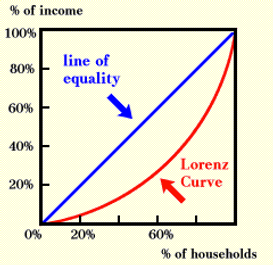
Area between the Lorenz Curve and the 45° line Total area below the 45° line
The resulting number ranges between: 0 = perfect equality where say, 1% of the population = 1% of income, and 1 = maximum inequality where all the income of the economy is acquired by a single recipient. This figure has recently changed to 100 so the range is 0-100.
* The straight line (45° line) shows absolute equality of income. That is, 10% of the households earn 10% of income, 50% of households earn 50% of income.
Higher Inequality = more deaths from Covid-19.
There are various reason why this could be a plausible justification:
1. There is some research to suggest that a higher income inequality leads to a lower life expectancy. Thus lower income groups cannot easily afford healthcare in that economy and therefore tend to suffer more from covid-19 as they are in poor health. Also inequality and pre-existing conditions may worsen the effects of the virus.
2. Workers in relatively egalitarian countries tend to have more bargaining power with employers and therefore air concerns about work conditions etc. Sweden’s front line workers have not on average faced a higher risk from covid-19 than other workers. This is in contrast to results from America, Britain and Canada, which are more lightly regulated.
3. Where there is distrust amongst the population – weak social capital – the willingness of people to comply with virus-control measures, such as self-isolation or masks on public transport etc, is disappointing. This is evident in New South Wales with the number of arrests for non-compliance around covid-19 rules.
4. Low wage workers are prevalent in retail, public transit, and health care settings who cannot easily practice physical distancing. This greater exposure to the virus and less access to health services among the poor could explain why more economically unequal countries – not necessarily the poorest countries – experienced significantly higher mortality rates. Countries with a larger gap between rich and poor, like the United States, Russia, and Brazil are experiencing a more deadly pandemic.
Final thought High inequality is likely to continue to mean greater vulnerability to pandemics. Government’s have new challenges around inequality and pandemics including:
Vaccinating those that can’t book online / can’t get off work / have no form of transport
Economic incentives to stay at home if infectious
Investing more in children’s health which has long-term benefits.
Sources:
Why have some places suffered more covid-19 deaths than others? The Economist 31st July 2021
Sign up to elearneconomics for comprehensive key notes with coloured illustrations, flash cards, written answers and multiple-choice tests on Inequality that provides for users with different learning styles working at their own pace (anywhere at any time).

Comments