

Watch that man! William Holden & Co. in ‘Dear Ruth’ (William D. Russell, 1947)
- Trinity Auditorium

- Apr 16, 2024
- 13 min read

April. Despite its uncertain and unexpected weather, it’s definitely one of my favourite months of the year. Not only it’s my birthday, but fellow Aries William Holden, the ultimate ✨Golden Boy✨, was also born during that month, more precisely on April 17, 1918. Being a definite fan of his (he’s up there with James Stewart and Arthur Kennedy), it’s been a pleasure to host, since 2016, The Golden Boy Blogathon: A William Holden Celebration. This year, for the 6th edition, the sublime Emily from The Flapper Dame is, once again, co-hosting with me.

I’ve explored Bill Holden from various angles in the previous years of hosting AND participating in the blogathon. For my contribution this year, I’ve decided to go with a more “traditional” subject, AKA a film review. Ok, there was a LOT to choose from, especially since I’ve seen all of the Golden Boy’s filmography. I hesitated between a few but decided I was definitely in a light mood to revisit Dear Ruth (William D. Russell, 1947). That might not be Holden’s most well-remembered film, nor his best, but it’s a charming comedy that should bewitch anybody who’s a bit fond of the actor! It also adds to the variety of his career and filmography if you look at films like that, then Sunset Boulevard (Billy Wilder, 1950) and Network (Sidney Lumet, 1976), to name a few.

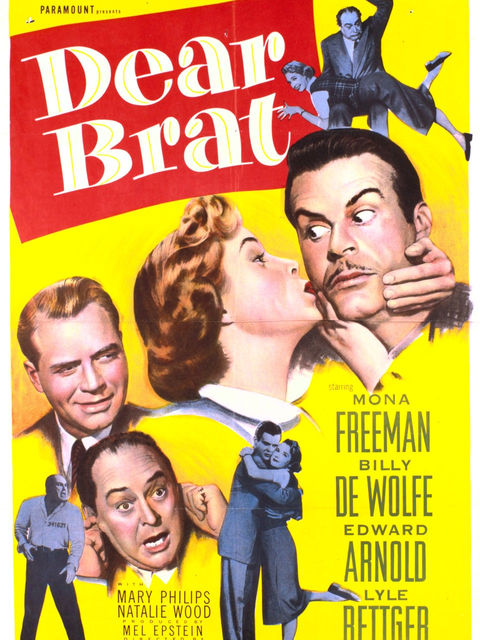
Written by Arthur Sheekman, Dear Ruth was an adaptation of the successful play of the same name by Norman Krasna. There’s indeed something very proper to theatre in that film, but we’ll be back to it. Russell’s film also stars Joan Caulfield, Mona Freeman (who’ll share the screen again with Bill in Leslie Fenton’s Streets of Laredo), Billy De Wolfe, Edward Arnold and Mary Phillips. Two sequels followed: Dear Wife (also starring William Holden) and Dear Brat (not with William Holden – I haven’t seen that one and learned about its existence only recently).

***
So, Dear Ruth takes place at the heart of the Wilkins, a traditional American family. The parents, Judge Harry Wilkins (Edward Arnold) and Edie Wilkins (Mary Phillips) have two daughters, Miriam (Mona Freeman) and Ruth (Joan Caulfield). Dear Ruth… Miriam is a teenager who gets involved in all sorts of great causes to improve the faith of the world, especially in those times of war. And she’s the president of every social committee in her school. Although her intentions are good, she doesn’t always use the right way to reach her means and often involves her family in her actions without letting them know first (registering her parents for blood donation without telling them, for example). On her side, Ruth is busy working at the bank and is most certainly about to be engaged to her boyfriend, the rather dull Albert (Billy de Wolfe)- dull but hilarious despite himself (I mean, it’s Billy de Wolfe!).

As I said, having a daughter like Miriam brings its share of surprises. One day, while the two daughters are away from home and the parents are relaxing and reading their newspaper in the living room, they receive the unexpected surprise of Lt. William “Bill” Seacroft (William Holden). He just returned from Italy and has a two-day leave before returning to Europe. The Wilkins, surprised, don’t fully understand the purpose of his visit. He explains that he and their daughter Ruth have been corresponding for a long time while he was fighting on the front as a bombardier. Despite the explanations, the Wilkins still don’t connect the dots, especially knowing Ruth goes out with Arthur. Bill wants to take advantage of his leave to meet Ruth in flesh and bones. After Mr. and Mrs. Wilkins tell him she might be at the bank, he leaves in hopes of seeing her there.

Meanwhile, Ruth comes home to announce the “good news” of her engagement to Arthur. At first, they think she’s talking about Bill (although it’s a quick engagement), but they soon realise their mistake. After telling Ruth about the visit of the handsome bombardier, she certainly has no idea who they are talking about. And there enters Miriam. Yes, Miriam is the cause of all this! She wrote 60 letters to Bill under her sister’s name, another way to prove herself to the world and give a bit of joy and hope to a poor soldier. Ruth and Bill finally meet at her house. Naturally, she wants to tell him the truth. However, she can’t find a way since Bill is too enthusiastic about spending time with her. So, things become more and more complicated. Ruth goes out with a completely clueless Bill, Arthur (now informed of the situation) has to be patient, Miriam is punished for a year, and Mr and Mrs Wilkins patiently cope with that chaos. But where will this lead us??


***
I wrote briefly about William Holden’s performance in my feedback on a marathon of his films I did in 2015 (before The Marathon Stars Blogathon existed). There are many reasons why I find this film so charming (and easy on the eye), and Bill is certainly one of them. As I said, I’ve seen all his films, but I remember some more than others. Despite being a “little film”, Dear Ruth stuck with me for a long time after my first viewing and instantly became a favourite. As soon as Bill is introduced to us, coming out of a cab, sharply dressed in uniform and with his face decorated with a most charming smile, I can’t help sighing at the view of this dashing man. He immediately imposes his presence full of charisma by entering a world he hasn’t seen in a long time with lots of confidence and an incomparable aura. His enthusiasm for a woman he has only met through letters is very endearing and adds to the comic aspects of the film. Blinded by love at first sight, he certainly makes things complicated for Ruth to tell him the truth!

We could call the 40s “William Holden’s light comedy decade”. He didn’t only make comedies during that era but had his share of moments playing the middle-class smiling boy next door in films that are not necessarily masterpieces but were part of his rich and varied career, for the best, in my opinion. Dear Ruth was one of them, but we can also think of The Remarkable Andrew (Stuart Heisler, 1942), Miss Grant Takes Richmond (Lloyd Bacon, 1949), The Fleet’s in (Victor Schertzinger, 1942), etc. Bill pretty much had his breakthrough at the beginning of the 50s when he starred in Billy Wilder’s Sunset Boulevard (1950), which paved the way for a long friendship between him and the director and for a significant change of direction in his career as he was now considered a serious actor. Many films now considered masterpieces followed, and Bill was one of those classic Hollywood actors who managed to have a relevant career during the New Hollywood Era.
However, he had to work before reaching that point, and Dear Ruth was part of those many steps. Interestingly, the film echoed Bill’s real life. He portrayed a lieutenant on leave, and it was his first film shooting since concluding his military duty. While serving as a lieutenant in the Air Force, he acted in some training films before concluding his service and returning to a more traditional Hollywood career. So, in a way, his entrance into the film seems to reflect his entrance into a studio, ready for a new start. Moreover, he and his character have the same first name. It could seem pointless to star in a comedy after having lived a war directly or indirectly. Nevertheless, in times like this, maybe comedy was the appropriate choice to change people’s minds as screwball comedies were during the Great Depression. However, Dear Ruth, in a way, perfectly illustrates the hopes and deceptions often embodied by characters in post-war movies. Some of these films, such as The Best Years of Our Lives (William Wyler, 1946), Crossfire(Edward Dmytryk, 1947), The Men(Fred Zinnemann, 1950), or Bright Victory (Mark Robson, 1951), were more cynical and illustrated a world changed with whom the soldiers had to cope and adapt to after being far away from it. We understand from Dear Ruth that, despite being released in 1947, it takes place while the war is still going on, as Bill is only on leave. However, he also has to adapt to the more everyday American life that seems so far away from the war in Europe, and some hints tell us that he prefers forgetting what’s going on over there and making the best of his free time. Just have a good time for a minute.

One of the best examples to illustrate that is when Mr Wilkins asks Bill “Well, how is everything in Italy?” to which he answers, “Oh, Italian…” While this quote is meant to be funny (and it is), if you look at it from another perspective, it could sound as if Bill either doesn’t have much to say about Italy or would prefer avoiding the subject. After all, he’s here for peace of mind and to meet his dear Ruth.
When Bill appeared on the Dick Cavett Show in 1972, he claimed that out of the 51 films he had made (at the time), one out of ten were happy sets and felt as if he was accomplishing something. Many films were made for contractual and economical reasons, although the actors didn’t necessarily care for those. To him, one out of five were pretty good, and one out of ten were true accomplishments. It’s hard to know what he exactly thought of Dear Ruth. However, in William Holden: A Biography, author Michelangelo Capua explains that, while Dear Ruth was the first film Bill made after his military service, Blaze of Noon (shot a few months after) was released first. The 1947 film directed by John Farrow (Mia’s father) and written by Frank Weade and Arthur Sheekman also starred Anne Baxter and Sterling Hayden and, being an aviation adventure film, sounded more ambitious than Dear Ruth. It doesn’t quite accomplish anything. Bill was called personally by Frank Weade and accepted the role of Colin McDonald only because he was in financial difficulty. The truth is that he wasn’t too enthusiastic about the role. And, honestly, it’s not a very memorable film despite having actors that I love and planes and all that. In the same category, Towards the Unknown (Mervyn LeRoy, 1956) is a bit better, in my opinion. As I said before, although I saw Dear Ruth for the first time long before seeing Blaze of Noon, I always had a recollection of what the film was about and memories of it. As for Farrow’s picture, I don’t remember much about it. So, in regards to what Bill said to Dick Cavett, I feel like Dear Ruth was one of those one out of five pretty good movies. I don’t know Holden’s sincere opinion, but it would be mine.

Dear Ruth introduces Joan Caulfield as Holden’s co-star and love interest, but I don’t want to talk too much about her because I find her rather blank. Sorry! She’s the pretty girl who feels like a girl next door who tries too much not to be the girl next door, and there’s nothing necessarily impressive about Caulfield’s acting. She does the job and is good at it, but that’s about it. Ok. I won’t deny it: Ruth and Bill are adorable, and there’s a place for cute chemistry between the two actors. But, if we think of the supporting cast, there are a bunch of great scene-stealers here. First, Mona Freeman is just as much comic relief as Billy De Wolfe, and I love that her character is introduced with a cause for equality between men and women. Her mother, a woman of her time, finds that silly. I haven’t seen a lot of Mona Freeman films, but there was a touch of light in her, which made her on-screen presence very sharp and enjoyable. In a way, I could compare her to Bonita Granville, and I must admit I kind of used to confuse them. Not that they look alike, but they played similar roles.


Edward Arnold is the kind of actor I always enjoy whenever I see him in a film, but I always forget that I like him. It’s hard to explain. He’s very much an actor of the present moment for me. I also have this weird connection to Robert Mitchum. And I really can’t put the finger on why. In Dear Ruth, he’s the perfect match between father and businessman. He has everything for it: the look, the attitude, the mannerisms. One of my favourite parts is when Bill kisses Ruth after taking her home after a night out, and Mr Wilkins wants to make his presence noticed while going down the stairs. He coughs and clears his throat the way a father does. I know that you know what I mean. Anyway, something very indiscreet, haha. Arnold’s personality and embodiment of his character reminded me of the feature film screenplay I wrote (no, it was not adapted on screen). It takes place in New York in 1948, and the main character is the director of a soap company, and his father is the CEO. Although this would be impossible, I always pictured William Holden as the main character and first thought of Frank Cellier as the father. However, after re-watching Dear Ruth, I think Arnold would also be a great candidate. But, sadly, that would never happen as we can’t go back in time.
Mary Phillips is also enjoyable as Mrs Wilkins, and she weirdly makes me think of Claudette Colbert. I think it was her hairdo, maybe? She works in top-notch symbiosis with Edward Arnold, and even tho her role is more passive, she puts noteworthy insights into the action and contributes to the quality of the picture. As for Billy de Wolfe, he’s completely silly, and his character might be one of the funniest despite being the most “serious”. Yes, Mr Wilkins is a judge but has a certain sense of humour. Arthur, on his side, is a very well-mannered banker who doesn’t smoke, probably doesn’t drink and doesn’t understand subtle messages. That leads to hilarious situations, especially when the Wilkins try to be polite with him.


Lots of the humour in Dear Ruth resides in its screenplay and dialogues meticulously crafted by Arthur Sheekman and adapted from Krasna’s play. When you know a little about him, Sheekman seemed to be the ideal choice to write this film. Arthur Sheekman, who was married to actress Gloria Stuart from 1934 until his death in 1978, is well-remembered for his work with the Marx Brothers and was even called “The 5th Marx Brother”. Needless to say, comedy was his expertise. Being a film based on a play, therefore taking place in a limited space, aside from a few exceptions, the mission was to keep the spectator focused with something else than tension and suspense as it would be in Hitchcock’s Rear Window (1954) or Lumet’s 12 Angry Men. Make way for humour, vivid dialogues, and catchy one-liners! Some of them that make the film work well as a comedy for me are the following:
1- Miriam : [on the phone] I’ll talk to you later. A prominent member of the last generation just walked in. [Perfectly illustrates the clash of generations between Miriam and her parents]
2- Mr Wilkins: I hope the young fellow that gets my blood doesn’t need it too badly, because I have no confidence in it. [Says it after doing his good deeds and donating blood. The line is funny but also emphasises Wilkins’s vulnerability.]
3- Mrs Wilkins: That isn’t a very good picture of her.
Mr Wilkins: It’s very good. I took it. [A proud father, hehe]
4– Bill: [Looking at a framed picture of Ruth] Be seeing ya’, baby. That’s what I call her – baby. You might as well know it.
Mrs Wilkins: I used to call her that.
Mr Wilkins: It’s not the same, dear.
5- Ruth: No woman wants a man who’s never jealous.
Albert: If that does it, I can make you pretty happy.

Now that I think of it, although it was released after that era, Dear Ruth has something screwball comedic. Sure, it’s not truly one, but it borrows some codes of the genre, particularly regarding comedy that relies on dialogues, the theme of marriage and, in a way, social classes. You feel the Wilkins, although they are not millionaires, live comfortably. Ruth is not a screwball character like the one portrayed by Carole Lombard or Claudette Colbert, but Miriam could be a wink to those working-class girls portrayed by Jean Arthur. And talking about Jean Arthur, let’s not forget that Edward Arnold played opposite her in one of the best screwball comedies, Easy Living (Mitchell Leisen, 1937). We don’t know much about Bill’s background, but he must come from a more modest class. However, he knows his way around, and his uniform is the concept that mostly makes him clash with the Wilkins.

Upon its release, Dear Ruth was the 17th highest-grossest film of 1947 and a commercial success. It’s not clear how much of a critical success the film was, but I feel it got the kind of success that kind of film normally has. It’s not something that would win the Golden Palm at the Cannes Film Festival, but people can recognize some of its qualities. One journalist who did was Bosley Crowther, a film critic for the New York Times. He wrote that it was “one of those simon-pure excursions in fun, which bubbles and sparkles its way into your heart and completely disarms any resistance which an unadorned outline of its conventional plot might invoke”. Looking at today’s perception of the film, I feel it’s a singular product people usually discover with lots of joy while exploring Holden’s filmography. It’s the type of film you’d watch precisely because there is something or someone appealing about it. It’s really not there in your face like the great classics are. It’s not discussed in books nor taught at film schools, so you have to look for it and make your own conclusion. Somehow, with a bit of will, I feel it could almost become a cult classic because there are so many interesting things about it if you know where and how to dig. Finally, the film holds pretty good scores on film databases and critic sites, with a current 87 % rating on Rotten Tomatoes, 7.2/10 on IMDB and a fair average rating of 3 stars on Letterboxd.

***
Truthfully, I never thought I’d write over 3000 words on a light comedy like Dear Ruth, but I guess there was more to say than I thought! Of course, watching the film again and writing about it was a true delight and made us re-evaluate the fact that there ARE indeed things to say about comedy. If you’d like to see the film, it is available on YouTube but in low quality. However, it’s not necessarily a visual film with Oscar-nominated cinematography, so you can cope with that quality. Hopefully, I made you want to see it! And I mean, above all, let’s not forget that William Holden should be a good reason enough to see it. 😉
Please be sure to read the other blogathon participants’ entries to discover more about the Golden Boy’s work, life and films! A huge thanks, once again, to Emily for co-hosting with me!
Day 2
See you!
**Enjoy this blog’s content? Consider supporting The Wonderful World of Cinema!**

Sources:
– Bosley Crowther (June 11, 1947). “The Screen In Review; ‘It Happened on Fifth Avenue’, With Victor Moore in Bright, Gay Mood, Opens at Rivoli – Charles Ruggles Also in Cast ‘Dear Ruth’ Based on Krasna’s Successful Play, Is Feature at the Paramount – Holden and Coalfield in Top Roles”. The New York Times.
– Capua, Michelangelo (2010). William Holden: A Biography. Jefferson, North Carolina: McFarland & Company.
– “H’Wood Sour on Costly Legits”. Variety. August 25, 1948. During 1947, there were 10 pix from plays, with Paramount’s “Dear Ruth” ($450,000) the only real sockeroo.
– Stuart, Gloria; Thompson, Sylvia (1999). I Just Kept Hoping. Boston: Little, Brown, and Company.
– “Top Grossers of 1947”. Variety. January 7, 1948. p. 63.
– “William Holden Almost Killed Humphrey Bogart | The Dick Cavett Show.” The Dick Cavett Show. August 14, 2020. Video, https://www.youtube.com/watch?v=t3kjva02lok.


Comments